

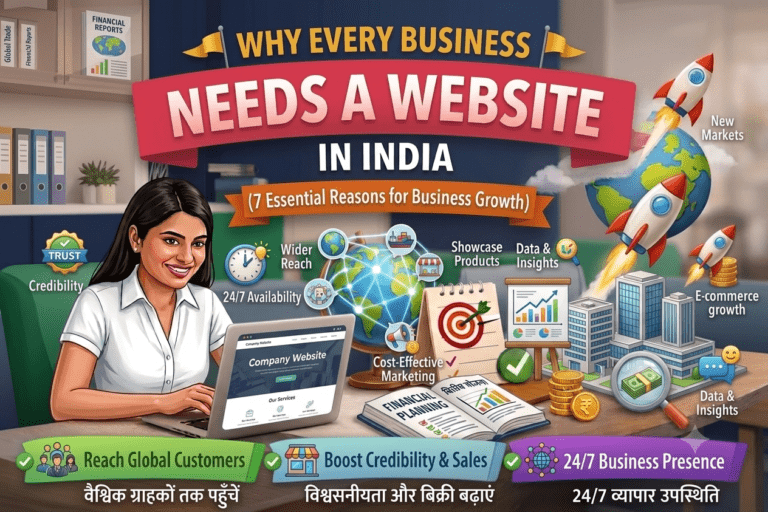
Introduction (Chapter-8)
If you are wondering why every business needs a website, the short answer is simple: over 80% of modern consumers research products and services online before spending money. Whether you run a local service business, a consultancy, or an e-commerce startup, an official web presence is no longer an optional luxury—it is a core operational requirement.
Knowing why every business needs a website helps you understand how an online hub builds instant trust, drives free search engine traffic, and automated lead generation. Relying solely on social media profiles leaves your enterprise vulnerable to algorithm changes and limited reach.
Below are 7 essential reasons why having a dedicated website is critical for your long-term business growth.
Table of Contents
- Establishes Instant Credibility and Professional Trust
- Captures High-Intent Organic Search Traffic
- Full Ownership and Control Over Your Brand Asset
- Operates 24/7 as an Automated Sales Engine
- Maximizes Marketing ROI and Lead Generation
- Showcases Products and Services on Your Own Terms
- Provides Actionable Customer Data and Analytics
- Frequently Asked Questions (FAQs)
Conclusion
Establishes Instant Credibility and Professional Trust
Consumers expect legitimate businesses to have an official web presence. While social media pages are helpful for engagement, they lack the formal authority of a custom domain name.
A professionally designed site acts as your digital storefront—complete with client testimonials, case studies, business hours, and certifications. It reassures potential clients that your brand is stable, authentic, and transparent.
Captures High-Intent Organic Search Traffic
When people need a product or service, their first instinct is to use search engines like Google. Having an optimized platform allows you to target relevant search queries (such as “best consulting service near me” or “affordable online accounting”).
Implementing proper search engine optimization (SEO) helps your site capture high-intent organic traffic—attracting visitors who are actively ready to purchase.
Full Ownership and Control Over Your Brand Asset
Relying exclusively on third-party social platforms exposes your operations to platform risk. Sudden algorithm shifts, account restrictions, or declining organic reach can impact your traffic overnight.
When you own your custom domain and web host, you retain full control over your branding, design, messaging, and customer experience without third-party interference.
Operates 24/7 as an Automated Sales Engine
Unlike a physical brick-and-mortar storefront with strict operating hours, a web application or site never closes.
It functions as an automated customer representative that answers common questions, processes orders, accepts booking requests, and captures prospective leads around the clock—even outside regular office hours.
Maximizes Marketing ROI and Lead Generation
Every marketing initiative—from social media campaigns and paid advertisements to offline business cards—needs a central destination designed to convert interest into revenue.
A dedicated platform enables you to build customized landing pages, embed contact forms, offer downloadable resources, and integrate live chat widgets to build a targeted email list and maximize campaign return on investment.
Showcases Products and Services on Your Own Terms
A custom site lets you feature your primary products and services using high-quality media, interactive pricing tables, video demonstrations, and downloadable guides.
Detailed descriptions and clear pricing help prospective customers evaluate your offerings and self-qualify before reaching out to your sales team.
Provides Actionable Customer Data and Analytics
Using web analytics tools like Google Analytics, you can evaluate precisely how visitors discover your brand, which pages attract the most attention, and where users drop off.
These empirical metrics help you refine your content strategy, adjust product positioning, and systematically improve conversion rates.
Frequently Asked Questions (FAQs)
Is a social media page enough for a small business?
No. While social platforms are excellent for community building and brand awareness, they lack search discoverability, custom lead-capture infrastructure, and professional ownership. Social media works best when driving traffic back to your main site.
How much does it cost to build a small business website?
A basic, professionally designed WordPress site built with standard page builders generally costs between $500 and $2,500. Lower-cost self-serve solutions exist, but investing in a clean design and good performance yields better long-term SEO and conversion results.
Will an official website help a local physical business?
Yes. Local SEO heavily relies on linking your web pages with your Google Business Profile. Having an optimized site containing local keywords improves your ranking in regional map results when nearby customers search for services.
Conclusion
Understanding why every business needs a website is fundamental to thriving in a modern, digital-first economy. A dedicated site builds credibility, captures search engine traffic, and provides an owned sales channel that operates continuously.
If you are preparing to launch your enterprise, combine your site with a solid operational plan. Review our step-by-step guides on how to write a business plan in India and how to start a small business from home in India to build a solid foundation.

Every time I log in I am greeted with fresh promotions and a perfectly optimized mobile layout. The transaction process works smoothly with our local e wallets and the game library keeps getting better. I finally found a place that balances fun and security. Visit their site now ph5bmw33